September 2026 precious metals roundup

Written by Luke Heritage
3rd October, 2026
The month of September was dominated by rate hikes, not by safe-haven buying, as gold prices declined by 6.6% to $4,186.70 (from $4,481.50) and silver prices declined by 9.2% to $60.10 (from $66.22). As a result, the gold/silver ratio rose from 67.7 to 69.7. Rates were raised by the Federal Reserve for the first time since 2023, and bond yields in the US rose to multi-year highs, leading to knock-on effects in the commodities markets. This is because metals that do not pay interest, like gold and silver, were struggling with demand. The Strait of Hormuz dispute is still not resolved, and thus oil prices remain high, keeping inflation fears alive.
Just a quick note on prices from my research: The spot price source that I was using for earlier roundups is no longer available to me. Thus, for the rest of this roundup, all prices are the COMEX futures close (gold GC=F, silver SI=F). Futures and spot are closely correlated but not identical, so percentage changes may differ slightly from the spot-based prices used in earlier months.
What was moving gold?
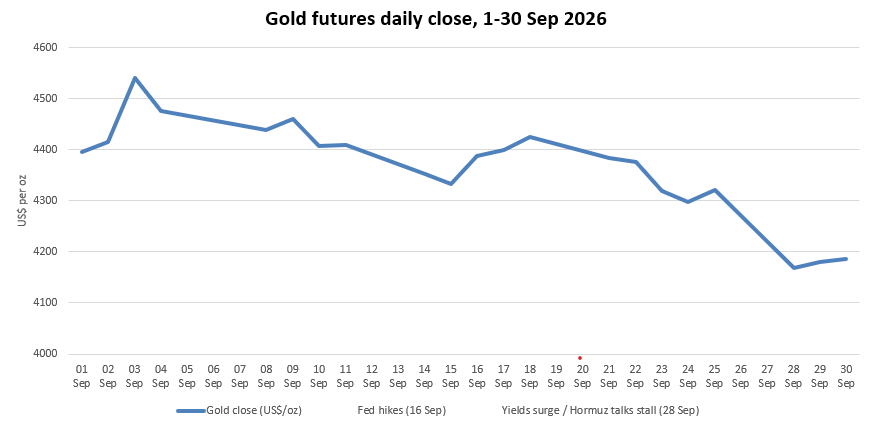
Gold had a three-phase month, first rising to the highest closing price of the month on 3 September of $4,539.90 (futures traded up to $4,558.50 on the day), then drifting lower through the middle of the month, before falling steeply in the last week of the month to close at $4,168.40 on 28 September, the lowest closing price for the month. The low for the month was hit on the last day of trading for the month on 28 September at $4,143.10.
Overall, gold fell by 6.58% over the month. The main reason for this was the Fed. On 16 September, the Fed voted 12-0 to raise the target range for the federal funds rate by 25 basis points to 3.75-4.00%, the first rate increase since 2023. The Fed’s statement said that inflation “remains elevated” and that the Committee “will deliver price stability”. For an asset that pays no income, higher interest rates and higher bond yields mean higher opportunity cost, and that was the main pressure on gold for the rest of the month.
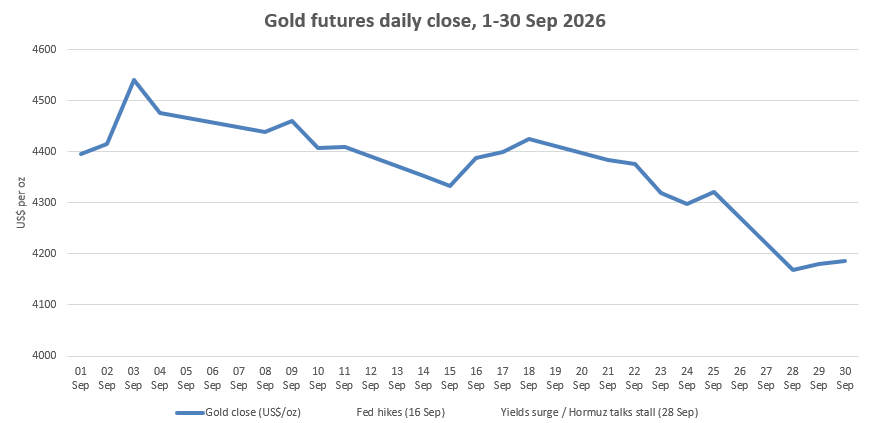
Interestingly, gold did not fall on the day of the rate hike. Gold futures actually closed up on September 16th at $4,387.50 up from $4,332.80 the previous day and then again on September 17th at $4,399.70. Futures trade until the close of trading on each day, and as such they would have been settled before the Fed’s announcement on the 18th at 2pm ET. And then inbetween the 18th of September and the 28th of September gold lost 5.8% of its value with the futures losing 3.5% on the 28th alone to close at $4,168.40. Spot gold on that day was trading at $4,111 its lowest level in seven weeks.
The Saxo Bank market note for that week in particular shows that US Treasury yields were trading at new cycle highs with the 10-year yield trading above 5.25% (the only previous occasion when the yield has traded above this level was in 2002) and the 30-year yield trading at 5.58% (the highest level since 2004). The dollar reached new highs against most major currencies. The 10-year US real yield, which strips out inflation, traded near 2.9%, up from around 1.7% before the Middle East conflict broke out. No peace deal eased inflation concerns, as President Trump rejected Iran’s latest proposal to reopen the Strait of Hormuz. Brent crude was trading above $107 per barrel. Some selling out of China had also taken place prior to the Golden Week holiday.
What also stands out in the report are the figures of gold owned by investors going into the fall. The latest ETF report from the World Gold Council for August shows how crowded the trade has become. In August, global gold ETFs saw the second highest monthly inflow ever with $18 billion being invested in the metal. The total amount of gold held in ETFs reached a new record high of 4,189 tonnes. Europe was the largest buyer with $7.9 billion invested in the metal, followed by North America with $7.7 billion. COMEX net long positions had also reached a new record high of 753 tonnes on 25 August, a rise of 39% compared to the end of July. It appears that a market that was heavily bought was more vulnerable when yields started to move higher.
However, the WGC does not make that point itself. What is, however, positive is that Saxo Bank reports that ETF holdings remained more or less unchanged during the late-September fall in gold prices. The WGC’s September flows report was not yet published at the time of writing this article.
What was moving silver?
Silver fell further than gold in the month, down 9.24% from $66.22 to $60.10. It had had a better first half of the month with the price of silver closing at $67.94 on 9 September, the highest close of the month, but it had fallen to $63.24 by the 15th of the month. The last week of the month saw the price of silver fall sharply. On 28 September silver futures fell 4.7% on the day from $64.25 to $61.22 and the price fell further to close at $60.10 on 30 September, the lowest close of the month, with the intraday low being $60.00. Silver miners fell sharply with Fresnillo the weakest stock in the FTSE 100 on the 28th, down 5.1%.
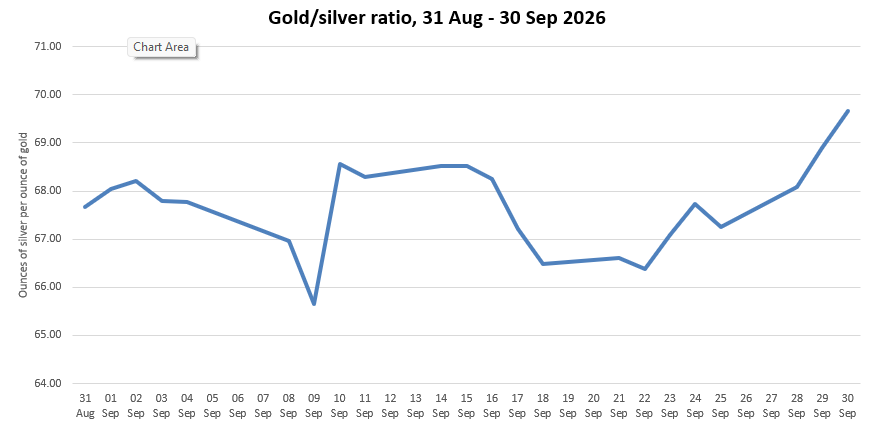
The ratio opened the month at 67.68, fell to 65.66 on 9 September when silver outperformed, and then rose for the rest of the month, ending at 69.66, the highest level of the period under review.
Thus, silver had given back all of the early month outperformance and more. No Silver Institute supply and demand data were available for this roundup so no comment can be made on silver’s industrial demand for the month.
What is there to look out for next month?
The biggest swing factor in the near term is the rate expectations, and the US jobs data for September, released on 2 October, was weak. 29,000 jobs were created against an expected 90,000, and the unemployment rate rose to 4.2%. Average wage growth slowed to 3.0%. According to Trading Economics, markets are pricing only a 20% chance of a rate hike at the October meeting, but are expecting a hike in December with an above 80% probability.
Yields could continue to rise, however, if the Fed does not sound as if it is on the verge of rate hikes. In the meantime, the Middle East is another variable to consider. US-Iran talks over reopening the Strait of Hormuz were put on hold at the start of October, with oil prices being influenced by every single piece of news.
It is also interesting to note that, in the usual scheme of things, higher oil prices would be expected to be bad for gold because they would lead to higher inflation and therefore higher yields. In this instance, however, it is actually positive for gold, as peace would be seen as removing a source of geopolitical risk. I shall also be looking at the WGC’s September ETF flows, the next central bank buying data and the Q3 Gold Demand Trends report, which is due in November.
My outlook
My personal views (not advice) on what's going on are that I still believe gold and silver are undervalued in the long run. Silver is more undervalued than gold right now. However, as we saw in September, the short-term trend is driven by rates. With the Federal Reserve raising rates, the US 10-year real yield near 2.9%, and the dollar strong, how things will go for each metal in the near term is up to whether yields have topped out.
With a Gold/Silver Ratio of 69.7, this ratio has stretched from where it was trading last month. If the pressure from the rising interest rates begins to decline, I would anticipate that silver will move back up more quickly than gold. On the other hand, silver will likely decline more sharply than gold if rates continue to rise, making silver the riskier option to hold that position.
Final comments
So to repeat and summarise, the Fed is being hawkish, and bond yields are rising, which is bad for both metals but worse for silver. What to watch out for next month and in the short-term future is the US rate path, the oil price, and whether large ETF investors start buying the dip.
Sources
Federal Reserve FOMC statement, 16 September 2026
Goldpricetracker.com, Gold daily closes, August 2026 (31 August base)
Goldpricetracker.com, Gold daily closes, September 2026 (COMEX GC=F, Yahoo Finance data)
Goldpricetracker.com, Silver daily closes, August 2026 (31 August base)
Goldpricetracker.com, Silver daily closes, September 2026 (COMEX SI=F, Yahoo Finance data)
Saxo Bank “Market Quick Take”, 29 September 2026
Trading Economics “Gold Edges Lower on Friday”, 2 October 2026
Trading Economics “Gold Rises as Markets Reassess Fed Rate Outlook”, 1 October 2026
World Gold Council “Gold ETF Flows: August 2026”, 9 September 2026