September 2026 UK fixed income market roundup

Written by Luke Heritage
2nd October, 2026
September gave gilt investors three things to digest at once: a Bank of England that held rates but split 6-3, inflation heading back up, and the first full plan for unwinding the Bank's gilt holdings. The 10-year gilt yield ended the month at 5.44%, roughly 30 basis points above its end-of-August level of about 5.14%, and the 30-year closed at 5.95%. In the middle of it all, the Debt Management Office sold a 30-year gilt at the highest yield in its history, and still received more than 20 times the amount on offer in orders.
MPC and the bank rate
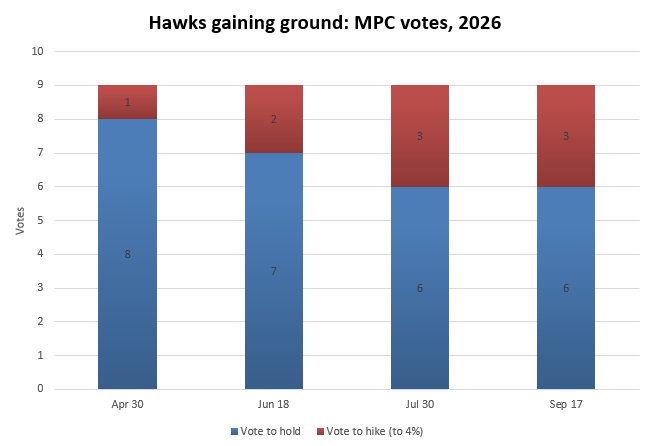
The Monetary Policy Committee met on 16-17 September and voted 6-3 to hold Bank Rate at 3.75%. Andrew Bailey, Sarah Breeden, Swati Dhingra, Clare Lombardelli, Dave Ramsden and Alan Taylor voted to hold. Megan Greene, Catherine Mann and Huw Pill voted to raise to 4%. That is the same split as July, and a long way from April, when only one member wanted a hike. Bailey was clear about where he sees things heading: if the conflict drags on, as it appears to be doing, policy may well have to tighten. The market agrees. The OIS curve, which shows where traders expect rates to go, peaks at around 4.9% by the end of 2027. The bigger story for gilts was not the vote but the quantitative tightening plan. The Committee voted unanimously to take the stock of gilts it holds for monetary policy down to zero, with the plan running to September 2034. The stock was 488 billion pounds on 16 September, down from a peak of 895 billion in February 2022. Of that 488 billion, 120 billion pounds of the longest-dated gilts will be kept permanently to back banknote issuance, 222 billion will simply mature, and the remaining 146 billion will be sold, at 20 billion pounds a year. Together with maturities, that works out at an average reduction of 46 billion a year. Over the previous 12 months the stock fell by 70 billion pounds, of which 21 billion came from active sales. There was an important caveat on how the sales will happen. The Bank has been talking to the Treasury and the DMO about selling gilts to the Government directly, rather than into the market, and says progress will be reviewed before April 2027. Its auctions are paused in the meantime. The minutes also put numbers on how much QT matters: term premia on long gilts have risen by an estimated 200 basis points since QT began in 2022, and Bank staff think QT accounts for around 20 to 30 basis points of that, with global policy uncertainty and heavy government bond issuance doing most of the rest.
Gilt yields and the curve
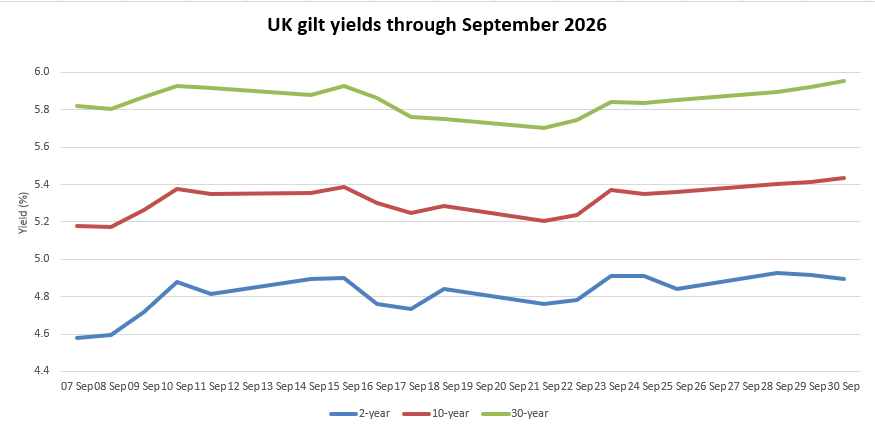
Yields rose across the whole curve. Taking daily closes from 7 September, the 2-year yield went from 4.58% to 4.90% (up 31.9 basis points), the 10-year from 5.18% to 5.44% (up 25.8) and the 30-year from 5.82% to 5.95% (up 13.5). The 10-year closed at 5.4358% on 30 September, the highest close in the period I tracked, and touched 5.51% intraday on 1 October, a new 52-week high. The 30-year's highest close was 5.954% on 30 September, with an intraday high of 6.029% on 1 October. The path was bumpy. Yields spiked early on, with the 10-year reaching 5.38% on 10 September, then eased around the Bank's announcement: on 17 September the 10-year fell 5.4 basis points to 5.249% and the 30-year fell 9.9 basis points to 5.763%. The bigger move at the long end fits with the Bank's decision to pause its sales, though I can't prove that was the cause. The 10-year's low for the second half of the month was 5.2065% on 21 September. Then, on 23 September, it jumped 12.9 basis points in a single day, and it kept climbing into month end as yields rose globally. Because shorter-dated yields rose faster than longer-dated ones, the curve flattened. The gap between 2-year and 10-year yields narrowed from 60.1 to 54.0 basis points, and the gap between 10-year and 30-year yields narrowed from 64.1 to 51.8. A flatter curve is what you would expect when the market is pricing in more rate rises in the near term, while the long end had already done much of its adjusting. The DMO's calendar tested demand all month, and the market passed. On 3 September the DMO sold 900 million pounds of the 1⅞% Index-linked Gilt 2049 at a bid-to-cover ratio of 3.58. On 10 September it sold 5 billion pounds of the 4⅝% Treasury Gilt 2030 (cover 3.24, yield 4.786%). On 22 September it sold 4.75 billion pounds of the 4⅝% Treasury Gilt 2032 (cover 3.07, yield 4.843%), and on 29 September 4.25 billion pounds of the 4⅞% Treasury Gilt 2036 (cover 3.34, yield 5.383%). Two smaller tenders on 15 September covered the 0½% 2029 gilt (cover 3.65, yield 4.819%) and the 4¼% 2040 gilt (cover 3.67, yield 5.640%). Cover stayed above 3 throughout, but the tails (how far the average accepted yield sat above the lowest) edged up from 0.3 to 0.5 basis points across the three conventional auctions, so demand was solid, but it cost a little more to attract. The headline event was the syndication on 8 September. The DMO re-opened the 5⅜% Treasury Gilt 2056 for 4.25 billion pounds at a yield of 5.8168%, the highest yield the DMO has ever achieved on a syndication or auction since it was established. Even so, orders topped 87 billion pounds, more than 20 times the size of the offer. Investors wanted long gilts, at a price.
What is driving the market
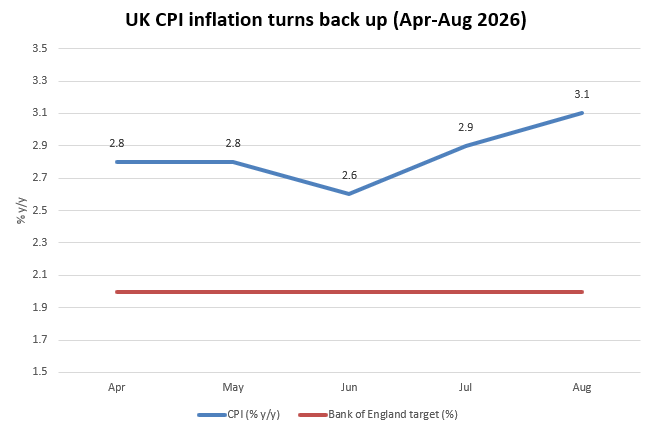
The first driver was inflation, and specifically energy. CPI rose to 3.1% in the 12 months to August, up from 2.9% in July, and the cause was fuel. Petrol averaged 161.3p a litre, the highest since November 2022, diesel averaged 181.8p, and motor fuel prices overall were up 23.0% on a year earlier. Underneath, things were calmer: core CPI held at 2.6%, services inflation at 3.4%, and food inflation was just 1.3%. The Bank's own minutes say about 0.7 percentage points of the 1.1-point overshoot of the 2% target came directly from energy. They also say that, on energy prices as at 14 September, the Bank expects CPI to reach around 3¾% in the fourth quarter and slightly above 4% in early 2027. On that date Brent was $106 a barrel and UK wholesale gas 207p per therm, up 36% and 78% respectively from the run-up to July's forecast. With CPI more than one point above target, the Governor and the Chancellor also had to exchange open letters, published alongside the minutes. Energy is why the MPC is split between holding and hiking, and why markets are pricing a higher path for Bank Rate. The second was the global long end. US Treasury yields climbed to new cycle highs, with the 10-year above 5.25% and the 30-year at its highest since 2004, after the Federal Reserve raised rates by 25 basis points on 16 September to 3.75-4.00%. UK yields do not move in isolation, and gilts tend to follow the US most closely at the long end. Brent was above $107 on 28 September as the Middle East standoff continued. The third was supply and the price of holding long gilts. The QT plan and the record-yield syndication both point to a market where investors want to be paid more to take on long-dated UK government debt. The Bank's own estimate is that QT explains only 20 to 30 basis points of a 200 basis point rise in term premia since 2022, so it is a factor, but not the main one.
Final comments
In one line: stubborn, energy-driven inflation, a divided MPC and a clearer QT plan pushed long gilt yields to levels the DMO has never had to pay before, with the long end under most pressure even as auctions cleared well. Next up is UK CPI for September on 21 October, the Autumn Budget on 28 October, and the next MPC decision on 5 November, where the vote split could move again. The Bank's talks with the Treasury and the DMO over how it sells its gilts are the longer-term thing to follow, since the Bank has said it will review progress before April 2027.
Sources
Bank of England, Monetary Policy Summary and Minutes, September 2026: https://www.bankofengland.co.uk/monetary-policy-summary-and-minutes/2026/september-2026
Bank of England, Monetary Policy Summary and Minutes, July 2026: https://www.bankofengland.co.uk/monetary-policy-summary-and-minutes/2026/july-2026
Bank of England, Monetary Policy Committee dates for 2026 and 2027: https://www.bankofengland.co.uk/monetary-policy/upcoming-mpc-dates
Bank of England, Monetary Policy Summary and Minutes, June 2026: https://www.bankofengland.co.uk/monetary-policy-summary-and-minutes/2026/june-2026
Bank of England, Monetary Policy Summary and Minutes, April 2026: https://www.bankofengland.co.uk/monetary-policy-summary-and-minutes/2026/april-2026
ONS, Consumer price inflation, UK: August 2026: https://www.ons.gov.uk/economy/inflationandpriceindices/bulletins/consumerpriceinflation/august2026
Investing.com, UK 10-year bond yield historical data: https://www.investing.com/rates-bonds/uk-10-year-bond-yield-historical-data
Investing.com, UK 2-year bond yield historical data: https://www.investing.com/rates-bonds/uk-2-year-bond-yield-historical-data
Investing.com, UK 30-year bond yield historical data: https://www.investing.com/rates-bonds/uk-30-year-bond-yield-historical-data
DMO, Results of outright gilt auctions (D2.1A): https://www.dmo.gov.uk/umbraco/surface/PDFReport/GetDataExport?reportCode=D2.1A
DMO, Results of outright gilt tenders (D2.1PROF9): https://www.dmo.gov.uk/umbraco/surface/PDFReport/GetDataExport?reportCode=D2.1PROF9
DMO press notice, syndicated re-opening of 5⅜% Treasury Gilt 2056, 21 August 2026: https://www.dmo.gov.uk/media/2u3laign/pr210826.pdf
AJ Bell (Alliance News), UK pays record yield on 30-year gilt despite bumper demand, 9 September 2026: https://www.ajbell.co.uk/news/articles/uk-pays-record-yield-30-year-gilt-despite-bumper-demand
Federal Reserve FOMC statement, 16 September 2026: https://www.federalreserve.gov/newsevents/pressreleases/monetary20260916a.htm
Saxo Bank, Market Quick Take, 29 September 2026: https://www.home.saxo/content/articles/macro/market-quick-take---gold-slides-4-and-the-ten-year-tops-525---29-september-2026-29092026