Q2 2026 UK macro roundup (Apr-Jun)
Written by Luke Heritage
August 22nd, 2026
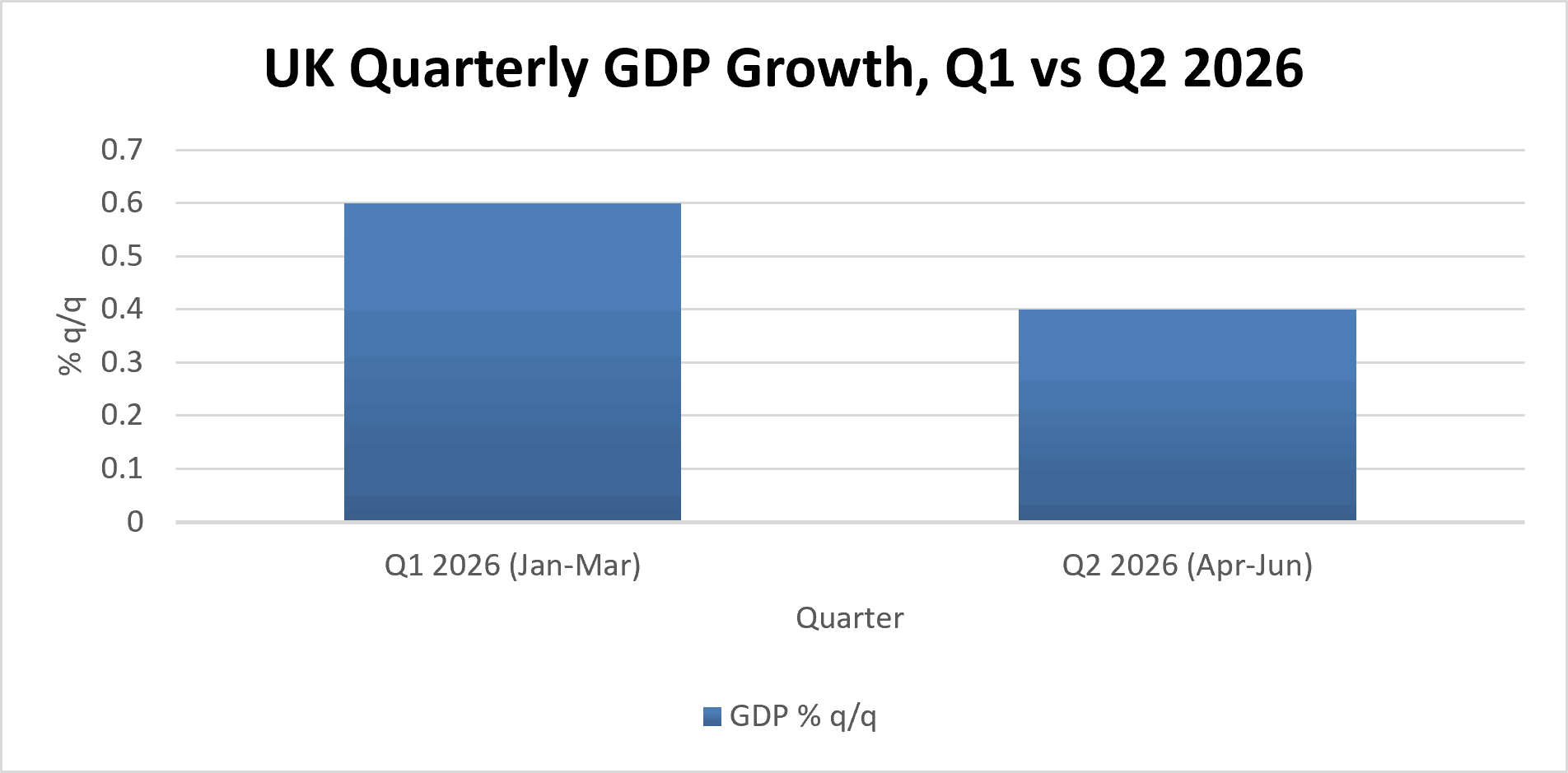
Q2 2026 proved to be a fairly disappointing quarter for growth after the momentum in Q1, with a GDP growth of 0.4%, down from 0.6% in Q1. Inflation drifted from 2.8% to 2,6%, unemployment was held at 4.9%, with the base rate being held at 3.75%. Underneath these numbers, this quarter was rather eventful in terms of UK politics with by-election headlines and the resignation of Keir Starmer that caused shaking around in the UK executive branch following into July.
Growth and inflation
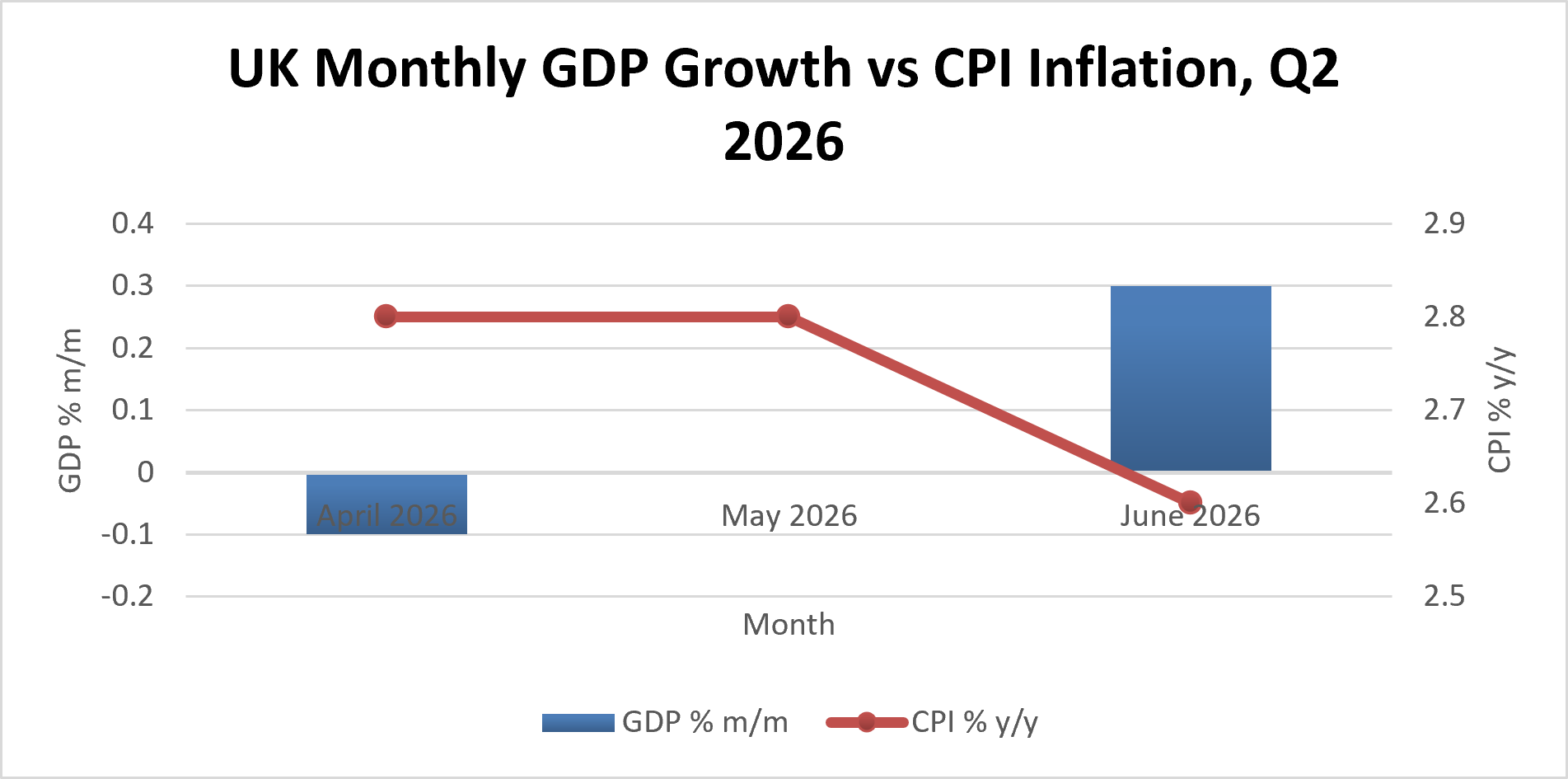
As mentioned previously GDP told the story of a loss of momentum within this quarter of 2026, with a retraction of 0.1% in April, a flat May, and a slight recovery in June of 0.3%, driven mostly by a 0.4% rise in services as seen in the graph above. taken together, the quarter saw a 0.4% growth with a services output rise of 0.5% (down from 0.8% in Q1) with production flat across the quarter, and construction increasing by 0.3%, showing our very stagnant economy.
In regards to inflation, CPI held at 2.8% year-on-year in both April and May, before easing to 2.6% in June which was the lowest reading since September 2024. An interesting point in May's print was transport inflation at 6.8%, sharply up from 4.5% in April, with average petrol prices hitting 157.4p/litre, the highest since November 2022. This transport spike seems temporary now as by June, easing fuel and diesel prices seemed to pull the overall figure down.
The labour market and consumers
The labour market loosened gradually across the quarter, with ILO unemployment holding at 4.9%, 0.2 percentage points on the year but down 0.1% percentage points on the prior three-month period. Furthermore, the employment rate for 16-64 year olds stood at 75.1%, whilst economic activity held essentially flat at 20.9%. Wage growth kept the now familiar private/public sector split with regular pay growing 3.5% annually across the whole economy in the three months including a strong 6.1% increase in public pay compared to 2.8% in the private sector. In real terms, adjusted for CPI this led to a modest 0.7% increase in regular pay.
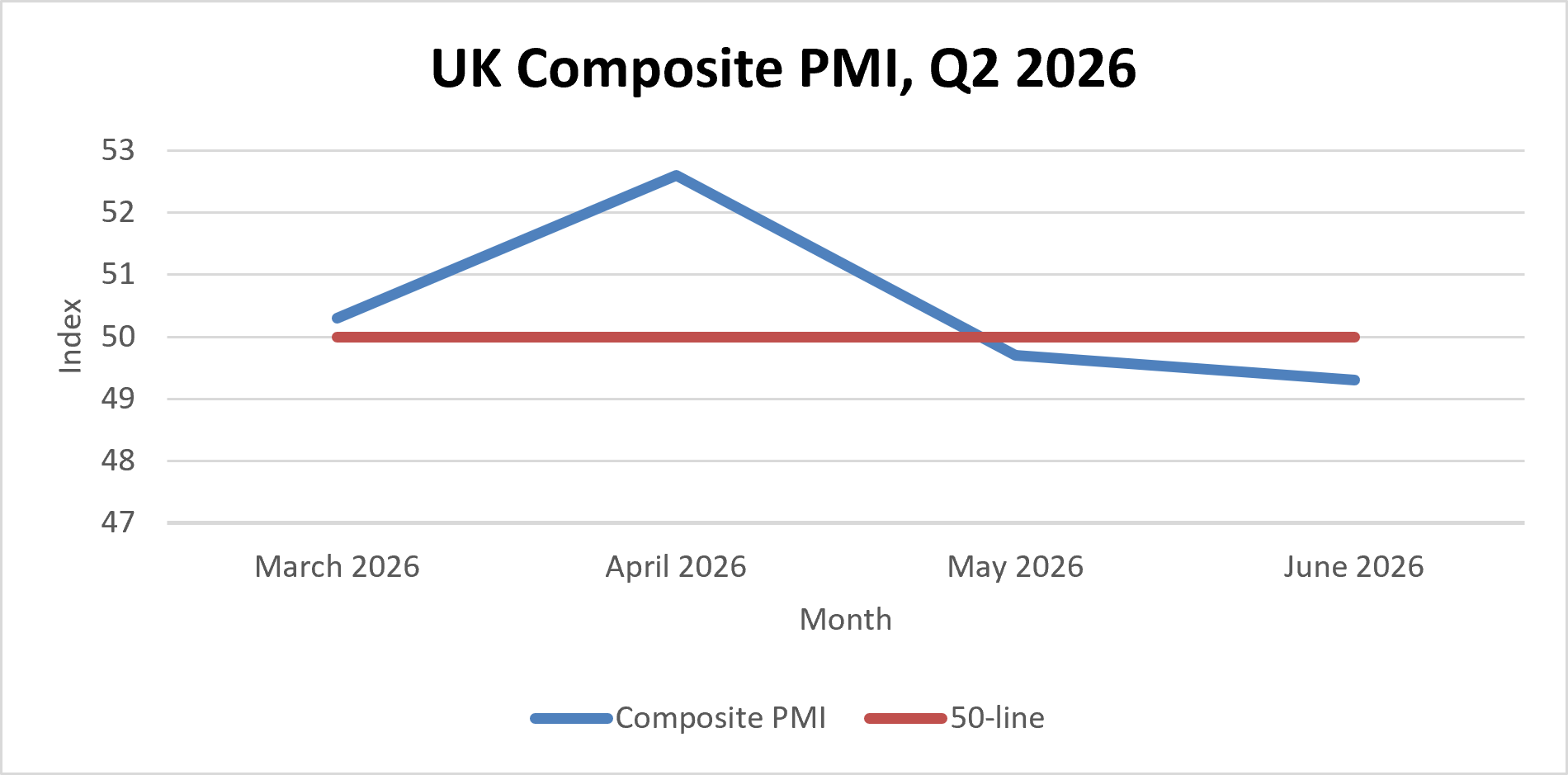
In terms of consumers, they kept spending through a quarter that had plenty of reasons not to amid huge uncertainties, with a strong rise of 1.2% in May before adding another 1% in June, leaving the broader Q2 trend up by 0.6% versus Q1. However, business sentiment told a weaker story with a fall in the S&P Global/CIPS Composite PMI from 52.6 in April to 49.7 in May, then even lower to 49.3 in June, showing large contractions as new business volumes fell at their fastest pace in over three years. Consumer confidence stayed pretty subdued however with the GfK's index being broadly flat month-on-month heading into June at around -23, masking deterioration underneath, with confidence among 16-29 year-olds collapsing 11 points.
Politics and markets
The two MPC meetings that were held in Q2 resulted in the same outcome, with both deciding to hold the base rate at 3.75% with results of 8-1 in April and 7-2 in June, leading to more hawkish speculation. The Bank's minutes keep highlighting how much the Middle Eastern-driven energy shocks have tightened financial conditions, even without rate changes, with two-year mortgage rates running roughly 80 basis points higher than before the crisis, as mentioned in my June fixed income roundup.
This quarter marked a complete political turning point. The Labour Party's performance in the May local elections was poor no matter how it was measured, with Reform UK securing control of 12 councils, which represented the biggest ever "third party" gain in the history of English local elections, and the pressure this placed on Keir Starmer's leadership never really went away. On the 21st of May, the government delayed the planned increase in fuel duty in September as part of a measure to support households and energy-intensive industry during the continuing energy shock. Then on 22nd June Starmer announced his resignation, thus setting off a leadership contest which lasted into the following month. This created much turmoil and confusion leading to rising yields in the bond market.
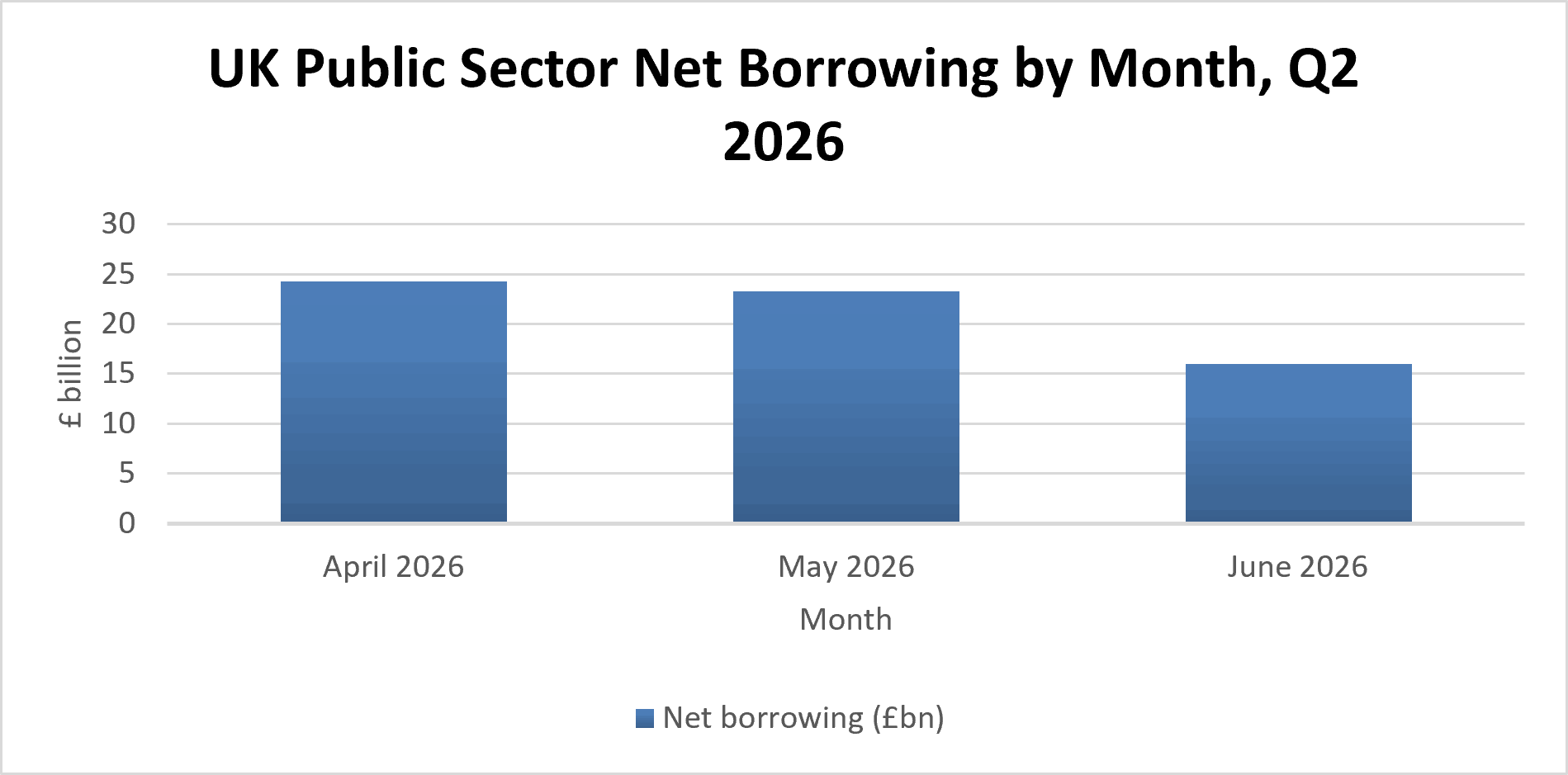
On the fiscal side, the picture worsened as the quarter progressed with a slight comeback at the end with April borrowing coming in at £24.3bn, the largest April figure since the pandemic and £3.4bn above the OBR's forecast, with May borrowing sitting at £23.3bn, the second highest may on record. However, this was eased into July at £16bn, 33.1% below June 2025 and slightly under the OBR's forecast, a rare piece of good fiscal news to close the quarter. This led to a combined £63.6bn of net borrowing across the quarter, with public sector net debt standing at a provisional 95.1% of GDP as of the May reading, a worrying level last seen in the early 1960s.
Finally, markets reflected the mixed political picture with the FTSE 100 closing around 10,897 and the more domestically focused FTSE 250 underperforming at roughly 23,147. This means that the domestically focused index, which underperformed compared to the global index, suggests that the reduction in investor sentiment was to do with the UK itself rather than a global trend, perhaps the political confusion.
Conclusion and what's next?
So overall, Q2 was a quarter of two distinct halves with cooled growth but nowhere near harmful and easing inflation with a loosening labour market. However, politically, the quarter showed some turmoil with much ambiguity shown in domestic markets. Furthermore, the narrowing vote in the Bank of England from 8-1 to 7-2 shows discomfort in the MPC to keep the base rate where it is amidst inflation confusion due to the Middle East. But with the new government resolved and a date in place for the Autumn budget, perhaps Q3 will provide more stability in UK politics.
Sources
Bank of England April 2026 Monetary Policy Summary and Minutes
Bank of England June 2026 Monetary Policy Summary and Minutes
NIQ/GfK — UK Consumer Confidence Index, June 2026
ONS GDP first quarterly estimate, UK: April to June 2026
ONS Consumer price inflation, UK: April 2026
ONS Consumer price inflation, UK: June 2026
ONS Consumer price inflation, UK: May 2026
ONS GDP monthly estimate, UK: April 2026
ONS GDP monthly estimate, UK: June 2026
ONS GDP monthly estimate, UK: May 2026
ONS Labour market overview, UK: August 2026
ONS Public sector finances, UK: April 2026
ONS Retail sales, Great Britain: June 2026
ONS Retail sales, Great Britain: May 2026
ONS Public sector finances, UK: May 2026
ONS Public sector finances, UK: June 2026
S&P Global Flash UK PMI Composite Output Index, June 2026
S&P Global UK Composite PMI, April 2026
S&P Global / investingLive UK June final Composite and Services PMI, 3 July 2026