July 2026 UK fixed income market roundup

Written by Luke Heritage
2nd August, 2026
July certainly delivered a large shock to the gilt market, the largest we've seen this year. After a calm first three weeks where 10-year yields eased to around 4.93%, the news on 20th July of Starmer's successor, Andy Burnham, becoming Prime Minister and John Healey replacing Rachel Reeves as Chancellor of the Exchequer, gilt yields jumped. By the month's end, we saw a 2-year yield at 4.411%, 10-year at 5.04%, and 30-year at 5.785%.
MPC and the bank rate
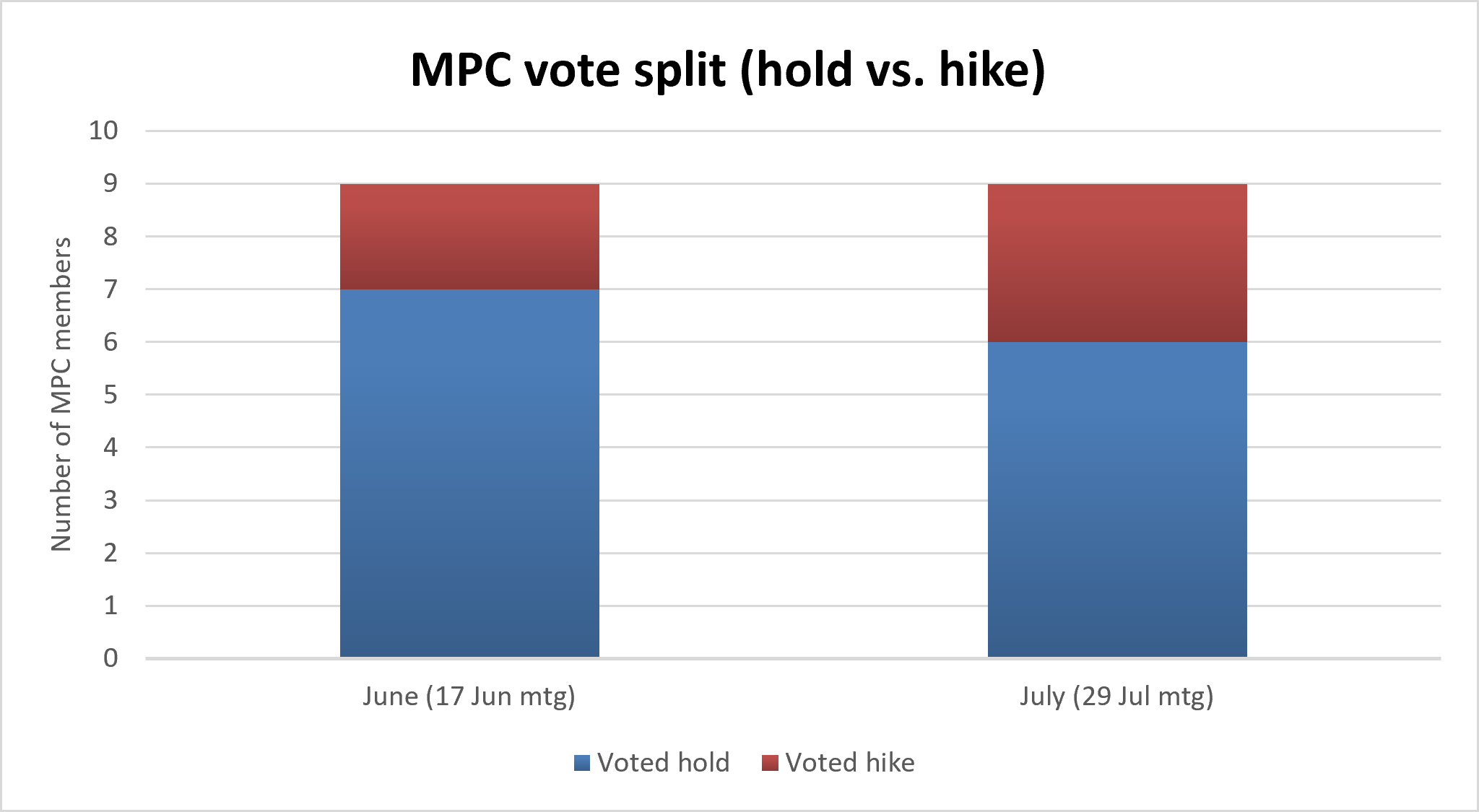
The MPC met on the 29th July and voted 6-3 to hold the base rate at 3.75% which proved to be the most hawkish split of the year and the fifth consecutive hold as Catherine Mann joined Megan Greene and Huw Pill to vote for a hike to 4% as I mentioned they did in my last edition. This emphasises some hawkish momentum going into the next meeting, even as headline inflation falls. Governor Andrew Bailey's rationale for holding was "the process of underlying disinflation that was intact prior to the conflict remains in train", holding onto similar reasons to hold as he did in the previous meeting, whilst CPI figures did drop from 2.8% to 2.6% three days before the meeting which was used as good evidence for the underlying disinflation story.
Huw Pill, who dissented for a second straight month, argued that the uncertainty around energy prices is likely to be prolonged and a rise in the bank rate is appropriate to offer a clear and unambiguous signal into asset price markets. The new member of the hike camp, Catherine Mann, pointed to the widening of the Middle East conflict and further ambiguity surrounding energy prices as key changes since June, both arguments in favour of preventing wage spirals as a result of cost-push inflation.
The Bank of England's stock of gilts held for monetary policy purposes had fallen to £491bn by 17th July from £522bn as mentioned in the previous edition, a £31bn reduction that represents more supply in the market of gilts separate from new issuance.
Gilt yields and the curve
The defining data point of this month was the 29 basis points rise in 10-year gilts to around 5.04% ending the month above the 5% level for the first time since the political worries in May, with the 2s10s spread standing at 63 basis points by month's end (similar to June) but the whole curve has shifted higher.
DMO auction activity continued through volatility with a £3.75bn sale of 4.125% Treasury Gilt 2033 on 7th July drawing a 3.04x bid-to-cover ratio, with a further £5bn auction of 4% Treasury Gilt 2029 on 21st July suggesting investor demand for UK duration is still holding up even through political shocks.
What is driving the market
In my opinion, there is three main events which are important to note on for this month, of course the first being the change in Prime Minister and Chancellor on the 20th July which is always a market test in terms of fiscal continuity, and as a result we saw a jump in yields. The next has been a story that has dominated the markets for months now, which is the Middle East conflict changing the price of energy (Brent crude oil jumping from $79 to $84 over July), thus indirectly leaning the MPC more hawkish which has led to higher yields across the curve. Furthermore, the last story is the announcement of the Autumn Budget on 28th October, giving the market a concrete date to plan for the government's first major fiscal event under new leadership, resulting in more clarity than an open-ended wait would give.
Final comments
July was an interesting month with a change of government and further energy uncertainty resulting in the 10-year's climb back over 5% and the MPC's most hawkish vote of the year setting up August and the next few months as very interesting to see where the majority will lie in the MPC. But perhaps we will see the underlying demand for UK government debt cope with the tension, as it is still doing so even during much confusion and change.
Sources
Bank of England July 2026 Monetary Policy Summary and Minutes
Investing.com "UK to auction £4bn of Treasury gilts on July 7"
Investing.com "UK to auction £5bn of 4% treasury gilts maturing in 2029"
UK Debt Management Office press notice pr070726, 7 July 2026