October 2026 UK fixed income market roundup

Written by Luke Heritage
November 2nd, 2026
October was a particularly testing month for Gilt investors, with inflation reaching 3.5%, the Budget, and the market now pricing in a rate rise by the Bank of England on 5 November. The yield on the 10-year Gilt fell by 14.4 basis points over the month to 5.29%, while the 30-year Gilt fell by 24.2 basis points to 5.71%. This long end of the yield curve was the surprise of the month, as it closed below its end-September level on 21 of the 22 trading days, even as inflation rose and markets priced in a rate rise. The Budget had little impact on the long end of the curve.
MPC and the bank rate
No meeting of the MPC was held in October. Bank Rate is currently 3.75% and was held at this level on 17 September with a 6-3 vote. Megan Greene, Catherine Mann and Huw Pill all voted to increase Bank Rate to 4%. The next meeting of the MPC is to be held on 5 November when a new Monetary Policy Report will be published together with the minutes of the meeting. In the meantime the data has moved in the direction of the MPC’s ‘hawks’ with CPI inflation rising to 3.5%. Overnight index swap pricing on 28 and 29 October indicated a 94-95% probability of a 25 basis point rise in Bank Rate to 4% at the next meeting of the MPC. 54 out of 63 economists in October’s Reuters poll expected Bank Rate to rise to 4% with Rabobank expecting a 7-2 vote to increase Bank Rate further to 4.25% in February 2027.
The plan for quantitative tightening has not changed since September’s announcement to take the Bank’s holdings of gilts to zero by 2034, with sales of £20bn a year. The Bank’s auctions have been suspended while it discusses the matter with the Treasury and the DMO. This is likely to be reviewed before April 2027, and so is more of long-term significance than the latest set of data.
Gilt yields and the curve
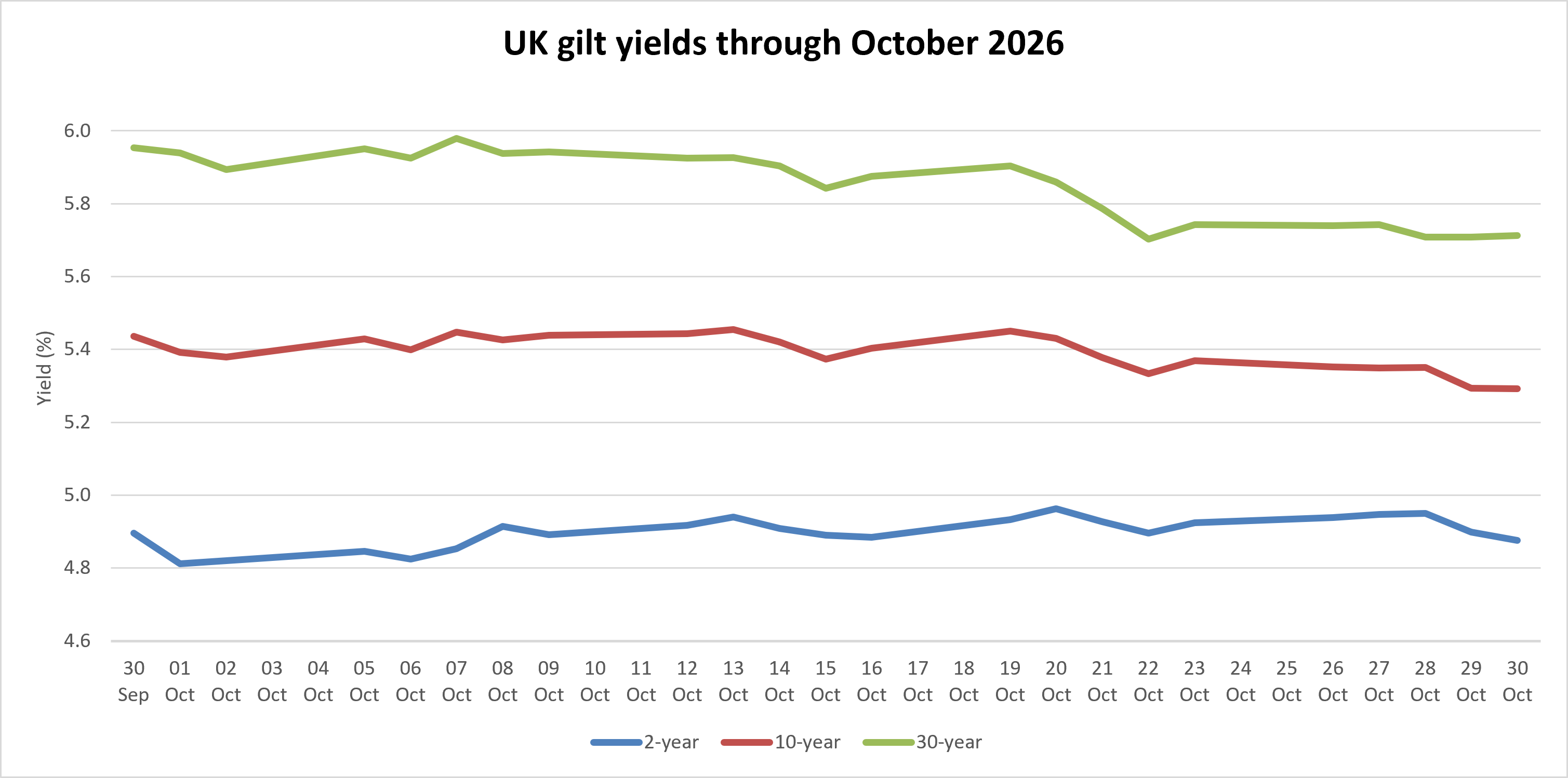
The month started on a high note with long-end rates hitting their peaks. The 30-year rate hit 6.029% on the first of October, and 6.047% on the eighth of October, making both the highest for the 52-week period shown on investing.com, and its highest closing price of the month was 5.979% on the seventh of October. The ten-year rate had an intraday high of 5.5267% on the eighth of October, and its highest closing price was 5.4542% on the thirteenth of October. From there, long-end yields began to fall. On the fifteenth of October, the ten-year rate fell 4.6 bp to 5.3739%, and the thirty-year fell 6.0 bp to 5.843%. Both bounced back on the nineteenth of October (the ten-year closed at 5.45%) and fell again on the twenty-first of October, the day UK CPI was released; the ten-year rate fell 5.2 bp to 5.378%, the thirty-year fell 7.3 bp to 5.787%, and the two-year rate fell 3.6 bp to 4.927%. Since I don't have consensus forecasts, I cannot tell you if the 3.5% came as a surprise or not, but bond buyers did not view this as a reason to sell. On the twenty-second of October, the ten-year rate closed at 5.3342%, and the thirty-year rate closed at 5.703%, the lowest closing price for the thirty-year rate of the month, as U.S. Treasury rates fell as a result of an equity sell-off. I cannot identify a single factor for all of these movements.
The front end of the curve traded differently for the majority of the month, with the 2-year trading above 4.9% for most of the second half of October, with a highest close of 4.9635% on 20 October and an intraday high of 4.9806% on 21 October. As would be expected with the market pricing in a rate hike in November, the 2-year then fell and closed at 4.8994% on 29 October, 5.1bp lower than its end of September value of 4.8961%, and fell further to 4.8758% on 30 October, 2.0bp lower than its starting value for the month. The 10-year closed at 5.2917% on 30 October, 14.4bp lower than its end-of-September value, and the 30-year closed at 5.712%, 24.2bp lower than its end-of-September value. The 10-year fell 5.7bp on 29 October, the biggest one-day fall of the month, and closed at its lowest point of the month at 5.2917% on 30 October. The curve therefore flattened over the month, with the gap between the 2-year and 10-year yields narrowing from 54.0bp at the end of September to 41.6bp at the end of October, and the gap between the 10-year and 30-year yields narrowing from 51.8bp at the end of September to 42.0bp at the end of October. Both of these gaps had been narrower earlier in the week, with the 2-year to 10-year gap closing at 39.5bp on 29 October, and the 10-year to 30-year gap closing at 35.8bp on Budget day, 28 October.
However, both of these gaps then widened over the last couple of days of the month. On Budget day, the 10-year closed at 5.3511%, and the 30-year closed at 5.709%.
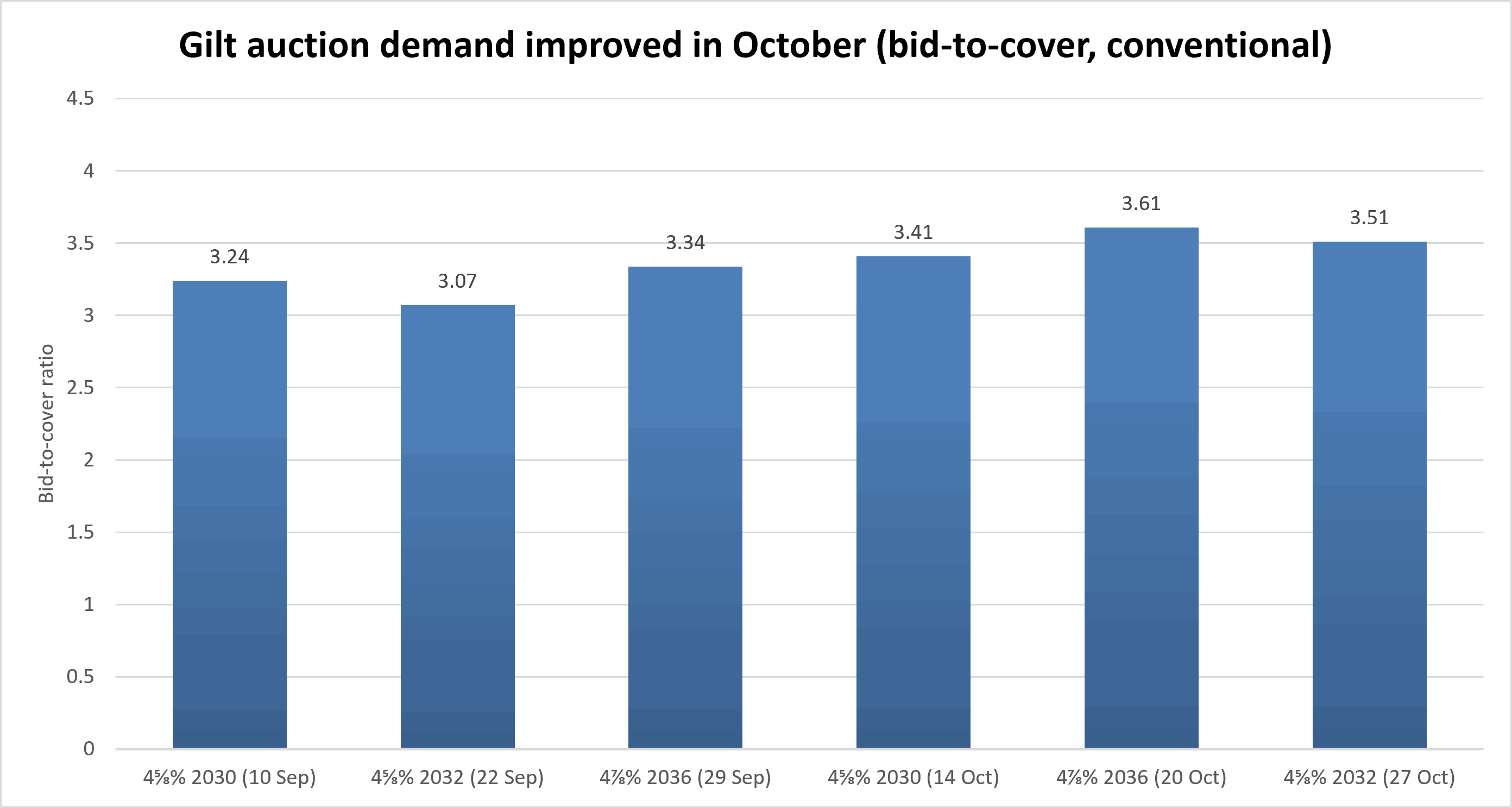
The DMO’s calendar was put to the test again with improved demand. The auction on 14 October of the 4⅝% Treasury Gilt 2030 was sold for £5bn, with a bid-to-cover ratio of 3.41 and an average yield of 4.945%. On 20 October the 4⅞% Treasury Gilt 2036 was sold for £4.25bn with a cover of 3.61 and average yield of 5.418%. On 27 October the 4⅝% Treasury Gilt 2032 was sold for £4.5bn with a cover of 3.51 and average yield of 5.036%. The three conventional auctions averaged cover of 3.51 with tails of 0.2, 0.2 and 0.3 basis points respectively, compared to the September auctions’ cover of 3.22 and tails of 0.3 to 0.5 basis points. The two index-linked auctions were also well received with the 6 October sale of the 1⅛% Index-linked Gilt 2035 covered 3.62 times and the 22 October sale of the 0⅛% Index-linked Gilt 2031 covered 3.99 times. Auction yields were higher than those achieved on the same gilts a month or two earlier (the 2032 at 5.036% against 4.843% on 22 September for example) but were paid for by the market. The auction on 13 October had been cancelled as announced by the DMO in August.
The Budget was as much of a gilt supply story as a tax one. The DMO’s revised remit for the years 2026-27 to 2027-28 sets out net financing of £258.6bn for 2026-27, up £7.4bn on previous forecasts. Gilt issuance of £250.6bn for the year is up £4.4bn, with net Treasury bill issuance of £8bn up £3bn on previous forecasts. Short conventional gilts are set to rise to £107.6bn from £95bn, medium conventional gilts to £89.3bn from £76bn, with long conventional gilts falling to £15.5bn from £22.4bn. Three long conventional auctions have been cancelled from the April plan, with the syndication programme up to £54.1bn, split mainly between medium-dated gilts. Unallocated issuance has been halved to £14.9bn from £29.8bn. A fifth programmatic gilt tender has been added on 3 December. The DMO’s illustrative gross financing requirement for 2027-28 is £312.6bn.
The reaction of the market to the Budget has been relatively muted.
Although the OBR has estimated that higher inflation will increase the cost of government borrowing by £14bn per year in this Parliament, and the Chancellor has acknowledged that the amount of fiscal space will fall from £24bn to £15bn by the end of the decade, the gilt market appears to have reacted as if it had been presented with a dull Budget. The 10-year closed up 0.2bp on the day at 5.35%, the 2-year up 0.3bp at 4.95%, and the 30-year down 3.3bp at 5.71%. On the following day, the 10-year was down 5.7bp, closing at 5.2917% for the month.
What is driving the market
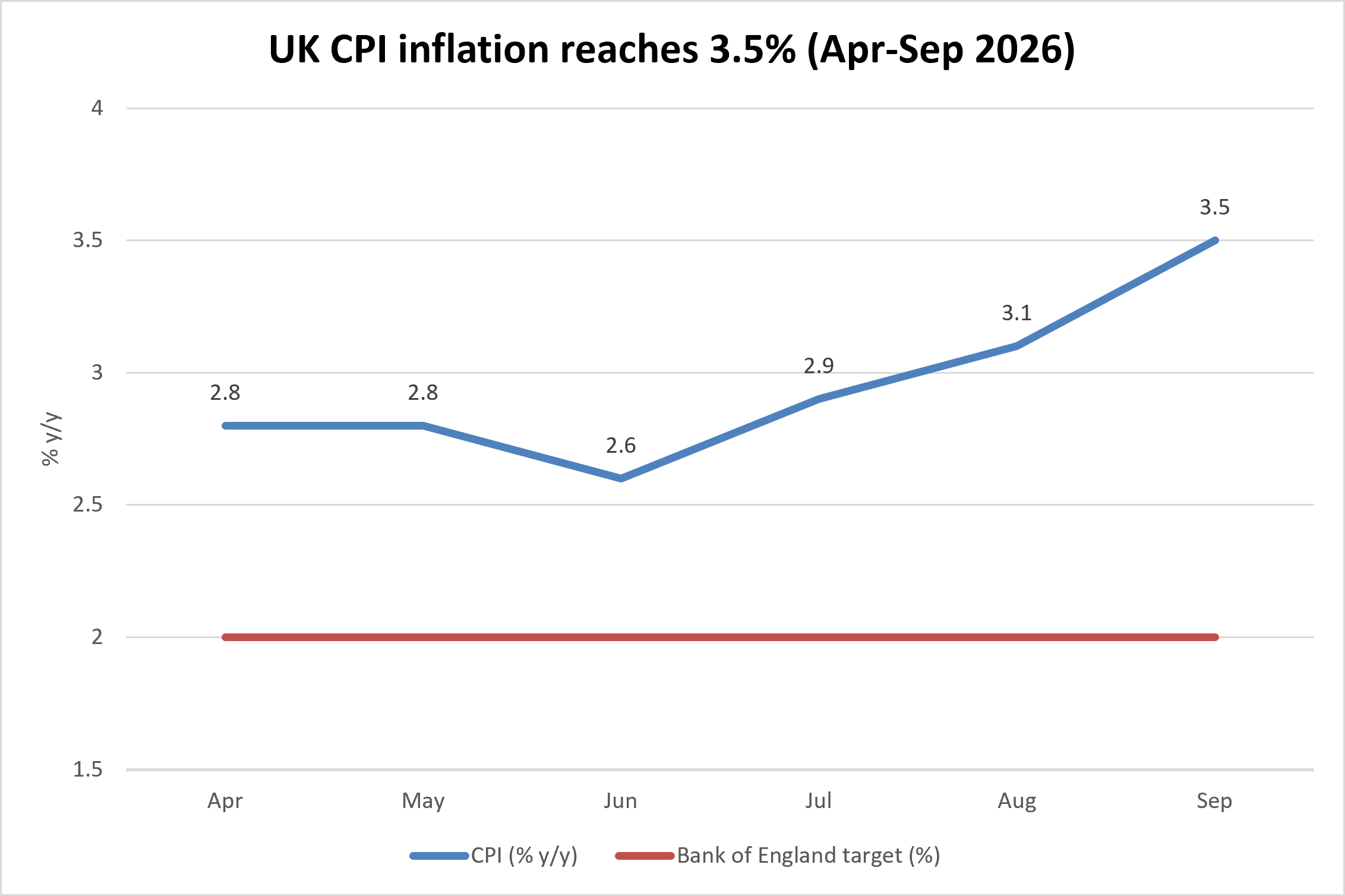
The first driver of rising costs is no longer just fuel. According to the latest figures from the Office for National Statistics (ONS), the Consumer Prices Index (CPI) rose to 3.5% in the 12 months to September, up from 3.1% in August, while the CPIH rate rose to 3.6%. Every month, prices rose by 0.4% in September. Transport was the largest upward contributor to the annual change in CPI, with motor fuels rising by 29.8% on the year (up from 23.0% in August). This saw petrol prices rise to an average of 169.5p a litre, up by 8.2p on the month and the highest since August 2022. Diesel was up by 10.7p on the month to 192.5p, the highest since July 2022. However, there are signs of spread across other categories. Core CPI rose to 2.8% in September, up from 2.6% in the previous month, while services inflation rose to 3.7% from 3.4% and goods inflation rose to 3.2%, the highest since September 2023, from 2.7%. Food inflation remained unchanged at 1.3% while restaurants and hotels continued to be a drag on prices, falling to 3.8% from 4.1% in the previous month. The Bank’s September minutes said that it expected CPI to reach around 3¾% in the fourth quarter, with the next reading of the measure due on 18 November. Meanwhile, the labour market remains in good health, with the unemployment rate falling by 0.1 percentage point on both the year and the quarter to 4.7% in the three months from June to August. This saw the employment rate rise to 75.3% and inactivity fall to 20.9% in the same period.
The second issue is the global long end and the price of oil. The Federal Reserve maintained its current interest rate of 3.75-4.00% on 28 October, although there were two members of the Federal Open Market Committee who voted for an increase in rates. The Fed gave no indication of future interest rate hikes. US CPI for September was 3.7%, and Brent Crude was trading above $113 on 22 October, as the dispute over the Strait of Hormuz continued. Treasury yields fell on the day, with the stock market also down and gilts following suit. In the UK, with the market pricing in a rate hike for November, the front end of the curve is elevated, while the long end has rallied.
And the last is supply and fiscal credibility, with the Budget not adding to the burden on the long end of supply. The remit shifts issuance towards shorter maturities but leaves only 15 billion pounds of headroom to be surprised. Sterling and gilts have taken the Budget in their stride so far but are vulnerable to weaker growth or further rises in global borrowing costs, and the OBR has also reduced its growth forecast for next year because of the Middle East war.
Final comments
While inflation increased, a November interest rate increase became the baseline assumption; the front end experienced an increase for much of the month but then reversed itself; however, the long end showed improvement, as did a low-key budget that had fewer long-dated offerings. Several upcoming events could provide additional evidence regarding these trends, including the Bank of England decision on November 5, the auction of the 5 ⅜ % 2056 bond on November 10, and the auction of the 5 ¼ % 2041 bond on November 17, which may indicate if the improvement in the long end was genuine. Additional economic indicators include the labour force data on November 17 and consumer price index (CPI) figures on November 18.
Sources
Bank of England MPC pricing and the Reuters economists’ poll are as quoted in market coverage (centralbank.watch, FXStreet)
Bank of England, Monetary Policy Committee dates for 2026 and 2027
Bank of England, Monetary Policy Summary and Minutes, September 2026
Brit Brief, Budget 2026: Markets unmoved by Chancellor Healey’s first statement (28 October 2026)
Central Bank Watch, Bank of England rate probability
DMO, Results of outright gilt auctions (D2.1A)
DMO, Revision to the DMO Financing Remit 2026-27: Budget 2026 (28 October 2026)
Federal Reserve FOMC statement, 28 October 2026
FXStreet, Bank of England: Gradual hiking path - Rabobank (30 October 2026)
Investing.com, UK 10-year bond yield historical data
Investing.com, UK 2-year bond yield historical data
Investing.com, UK 30-year bond yield historical data
Kitco, Gold price drops to $4,035/oz as Fed votes 10-2 in favor of rate hold (28 October 2026)
Kitco, Precious metals tumble despite falling yields as Hormuz tensions intensify (22 October 2026)